
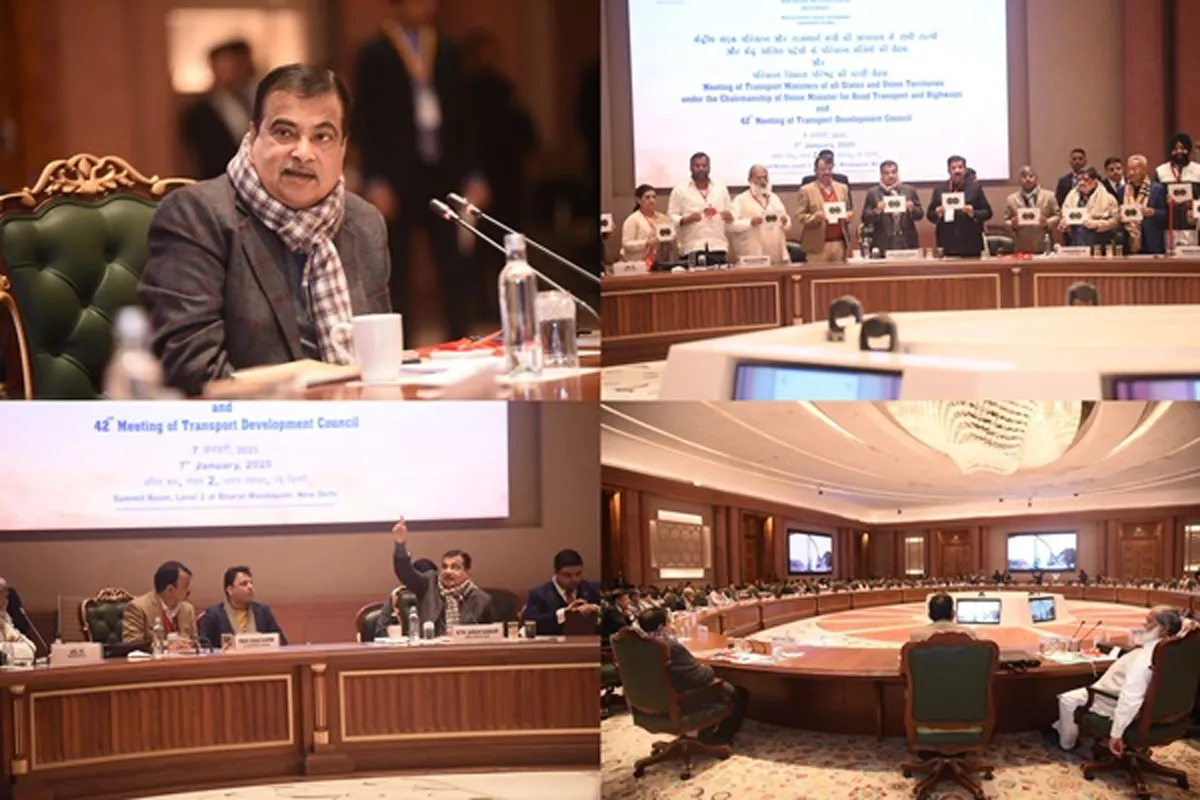
The high-level discussions focused on road safety, passenger convenience, ease of doing business, digitisation of transport services, and automobile and emissions regulations. The meeting underlined the importance of close Centre–State coordination in a sector governed under the Concurrent List of the Constitution.
Addressing the gathering, Gadkari stressed that continuous consultation between the Union and State governments is vital to strengthen cooperative federalism and deliver safe, efficient and citizen-centric transport systems nationwide.
The meeting marked the culmination of a two-day national workshop held on 7–8 January 2026 at Bharat Mandapam. The workshop was designed to comprehensively assess challenges, solutions and implementation pathways for the road transport sector.
On the first day, technical and administrative discussions were held with Transport Secretaries from States and Union Territories, chaired by V. Umashankar, Secretary, Road Transport and Highways. The deliberations were structured by Additional Secretary Mahmood Ahmed. The second day brought together Transport Ministers under Gadkari’s chairmanship, with renewed emphasis on road safety and the Road Safety Pledge.
The discussions concluded with the 43rd Transport Development Council meeting, during which inputs from transport associations, including AIMTC and BOCI, were reviewed with Ministers and senior officials.
During the workshop, the Centre and States aligned on action across ten priority reform areas. These included the digitisation and standardisation of transport services through the Vahan and Sarathi platforms, with a focus on harmonising more than 100 online services, reducing physical visits and improving data quality and security.
Proposed legislative amendments to the Motor Vehicles Act, including Jan Vishwas 2.0, were discussed to simplify compliance, decriminalise minor offences and strengthen road safety. States also reviewed measures to reduce road fatalities through safer infrastructure, improved enforcement and enhanced post-crash care, including preparedness for the statutory cashless treatment scheme for accident victims and wider adoption of the e-DAR accident reporting system.
Other focus areas included higher vehicular safety standards, district-level road safety initiatives, expansion of the vehicle scrapping policy, uniform implementation of PUCC 2.0 emissions norms, strengthening intelligent transport systems and e-enforcement, and scaling up driver training and capacity-building infrastructure.
The Ministry also highlighted the Sadak Suraksha Mitra programme, launched with the Ministry of Youth Affairs and Sports, to involve trained youth volunteers in district-level road safety efforts, accident hotspot identification and basic post-crash assistance.
Key outcomes from the deliberations include nationwide standardisation of online transport services, large-scale data sanitisation of vehicle and licence records, rollout of a central digital data-sharing framework compliant with the DPDP Act, strengthened oversight of vehicle testing and scrapping facilities, mandatory affixation of high-security registration plates for vehicles registered before 1 April 2019, and exploration of a points-based system to track traffic violations.
In his concluding address, Gadkari called for integrating these reforms into a unified, forward-looking vision for the transport sector. He said coordinated efforts by the Centre, States and stakeholders would lay the foundation for a safer, more efficient, digitally empowered and future-ready transport system. Officials said the outcomes will guide policy action and implementation over the coming year, with a strong focus on safety, sustainability and ease of doing business.