
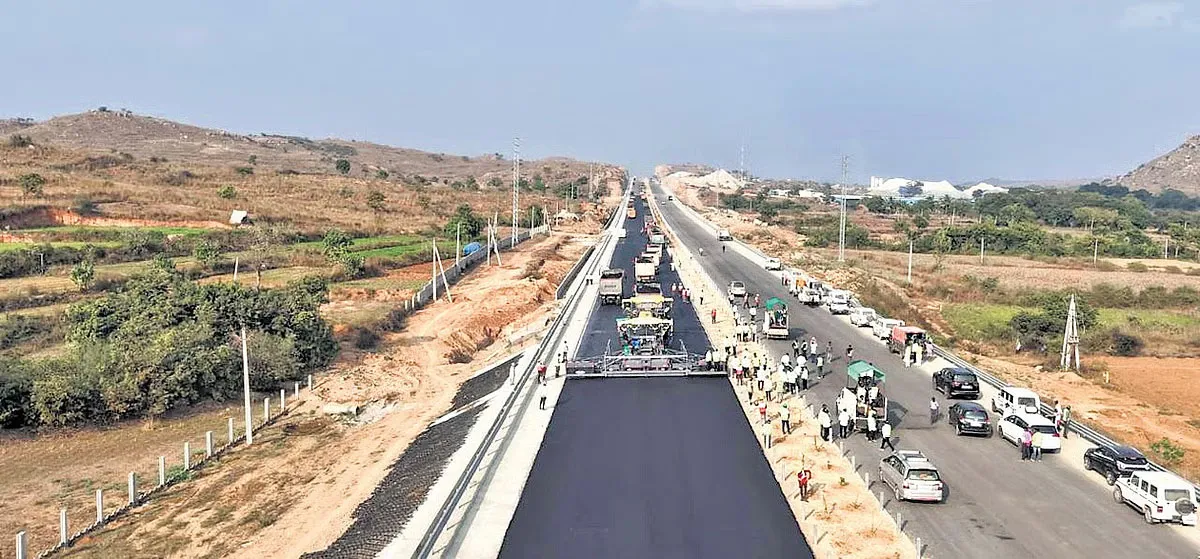
National Highways Authority of India has recently created multiple Guinness World Records near Puttaparthi, Andhra Pradesh, during construction of the six-lane Bengaluru–Kadapa–Vijayawada Economic Corridor. The records highlight unprecedented speed and scale in bituminous concrete paving on a national highway project.
The first two records were achieved for the longest continuous laying of bituminous concrete, covering 28.89 lane km (a 3-lane-wide, 9.63 km stretch) within 24 hours, and for laying the highest quantity of 10,655 metric tonnes of bituminous concrete in the same duration. These milestones were established for the first time globally on a national highway project.
Building on this achievement, two additional Guinness World Records were set on 11 January 2026. These included the continuous laying of 57,500 metric tonnes of bituminous concrete and paving of 156 lane km (a 3-lane-wide, 52 km stretch), surpassing the earlier global record of 84.4 lane km. The feat was executed across Package-2 and Package-3 of the corridor.
The record-setting work was delivered by NHAI in association with concessionaire Rajpath Infracon Private Limited, using advanced construction equipment including multiple hot mix plants, pavers, rollers and tippers. Quality control and monitoring were supported by premier institutions such as Indian Institute of Technology Bombay, along with OEMs, ensuring strict adherence to safety and quality standards.
Spanning 343 km, the access-controlled corridor features 17 interchanges, 10 wayside amenities, a 5.3 km tunnel and a forest stretch of around 21 km. Once completed, it is expected to reduce travel distance by about 100 km and cut travel time by nearly four hours, significantly improving connectivity between Bengaluru, Vijayawada, the Rayalaseema region and key industrial nodes in Andhra Pradesh.
The Guinness World Records underscore NHAI’s commitment to delivering world-class highway infrastructure aligned with the Government of India’s vision for safe, efficient and globally benchmarked transport corridors that drive economic growth and regional development.