
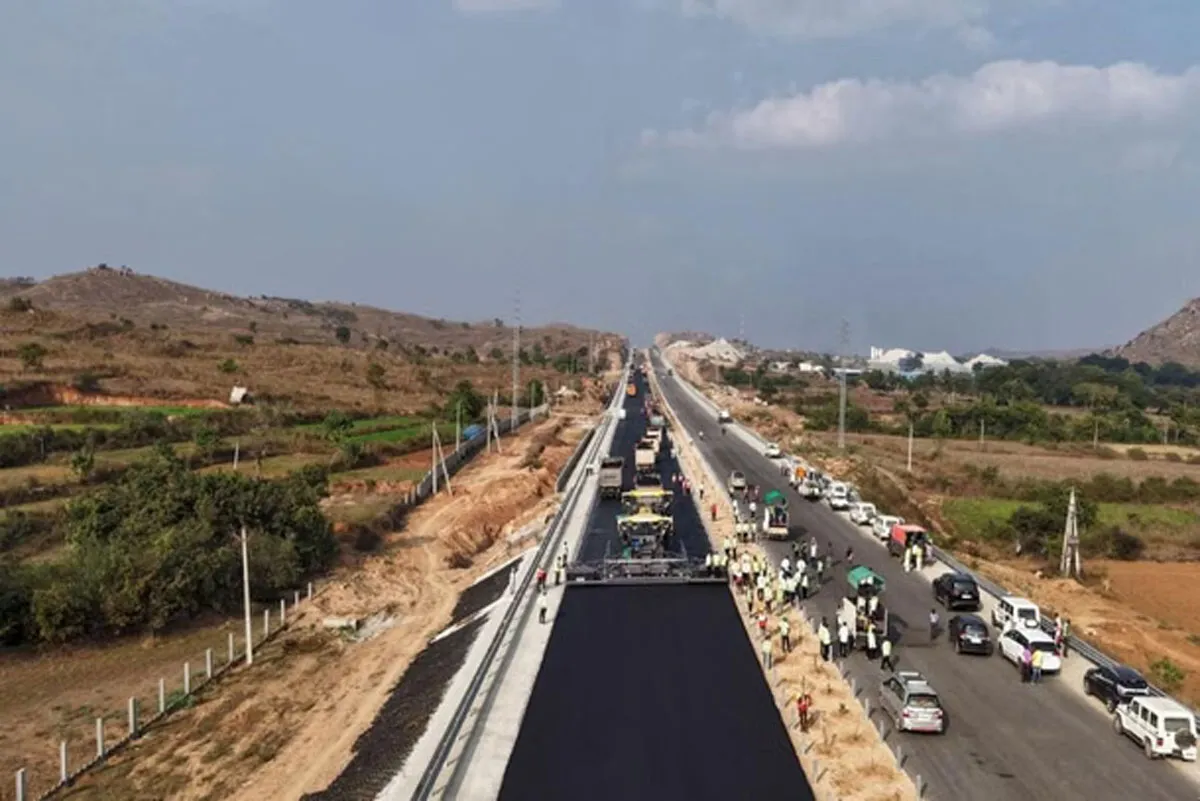
The milestone was achieved in two phases. On January 6, 2026, construction teams near Puttaparthi set two global records in a single day by completing the longest continuous laying of bituminous concrete—28.89 lane km in 24 hours—and the highest quantity of bituminous concrete laid continuously at 10,655 metric tonnes. Both feats were accomplished on a six-lane national highway, a first worldwide.
The momentum continued on January 11, 2026, when two more records were set across Packages 2 and 3 of the corridor. These included the uninterrupted laying of 57,500 metric tonnes of bituminous concrete and continuous paving of 156 lane km, equivalent to a three-lane-wide stretch of 52 km. This significantly surpassed the previous world record of 84.4 lane km.
Officials attributed the achievement to meticulous planning, advanced machinery and disciplined on-ground execution. The operation involved 70 tippers, five hot mix plants, a paver and 17 rollers working in synchrony. Quality assurance was closely monitored with support from IIT Bombay and original equipment manufacturers to ensure compliance with stringent safety and durability standards.
On January 12, Union Minister Nitin Gadkari joined virtually with Andhra Pradesh Chief Minister Chandrababu Naidu to commend NHAI and the concessionaire for the accomplishment. Gadkari said the records highlight India’s emphasis on innovation, sustainable construction, skill development and cleaner technologies, including bitumen derived from rice straw.
Spanning 343 km, the six-lane economic corridor is designed for high-speed, safe travel and includes 17 interchanges, 10 wayside amenities, a 5.3 km tunnel and a 21 km forest stretch. Once operational, it is expected to shorten travel distance by about 100 km and cut journey time by nearly four hours, strengthening connectivity between Bengaluru, Rayalaseema and coastal Andhra Pradesh.