
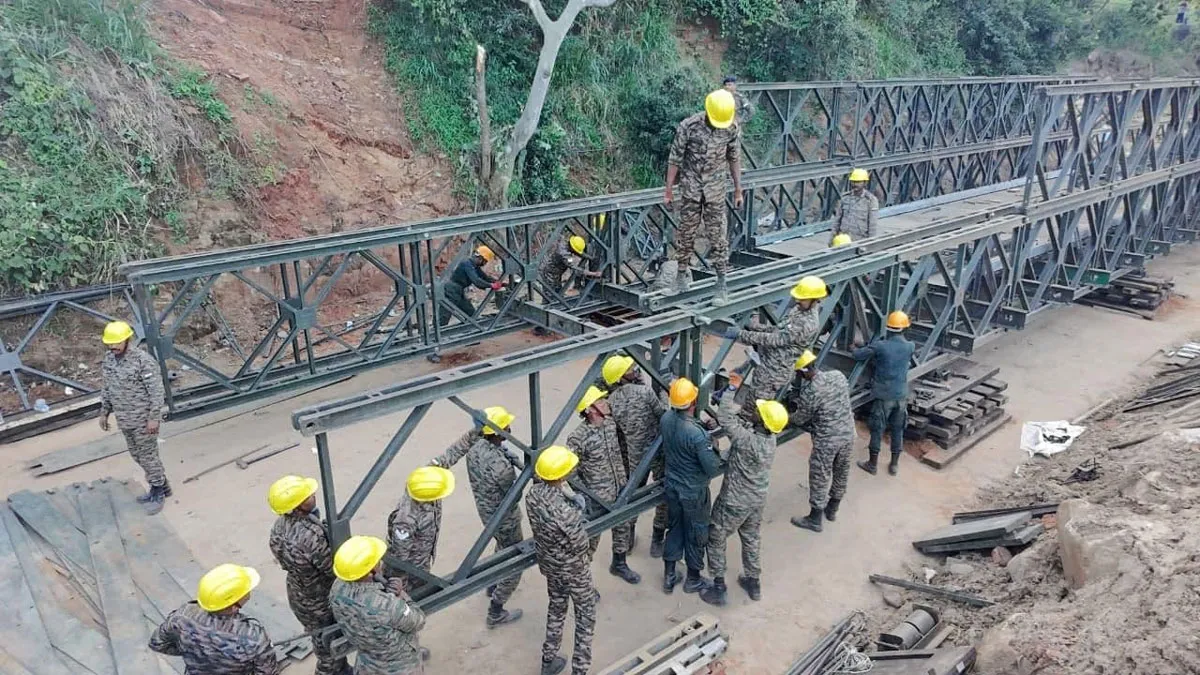
The Indian Army’s Engineer Task Force has recently completed construction of the third Bailey Bridge, spanning 120 feet, at KM 15 on Sri Lanka’s B-492 Highway in the Central Province. The bridge reconnects the Kandy and Nuwara Eliya districts, restoring a vital transport link that had remained disrupted for more than a month after Cyclone Ditwah.
This milestone follows the successful commissioning of two earlier Bailey bridges in the Jaffna and Kandy regions. Together, these engineering interventions have reinstated road connectivity, improved access to essential services, and supported communities affected by the cyclone.
Taking to social media X, the Indian Army posted, “The Indian Army’s Engineer Task Force, after successfully launching two critical Bailey bridges in the Jaffna and Kandy regions, has constructed the third Bailey Bridge of length 120 feet at KM 15 on the B-492 Highway in Sri Lanka’s Central Province.”
""Linking the Kandy and Nuwara Eliya districts, the bridge will restore a vital lifeline which was cut off for over a month in the aftermath of Cyclone Ditwah. This effort reaffirms India’s steadfast commitment to Sri Lanka and the Neighbourhood First policy,” the post read.
Cyclone Ditwah, which struck Sri Lanka late last year, caused widespread flooding, landslides, and severe damage to infrastructure, placing significant strain on local disaster-response systems.
The bridge construction forms part of Operation Sagar Bandhu, launched in November 2025, under which India extended Humanitarian Assistance and Disaster Relief, including restoration of roads, bridges, and essential services. The effort underscores India’s commitment to Sri Lanka under the Neighbourhood First policy, strengthening regional cooperation and goodwill.
“Recalled our earlier interactions and the strong, time-tested bonds between India and Sri Lanka, rooted in close friendship, mutual support, and shared democratic traditions. Our discussions highlighted close Parliament-to-Parliament cooperation, including regular exchanges, formation of friendship groups, and collaboration in policy and programme design,” Om Birla said in a post on X.
“We discussed deeper engagement in technology-driven parliamentary innovation, including AI-enabled systems, real-time multilingual translation, and capacity building through PRIDE. Hoped that the strong people-to-people connect, cultural linkages including Bodh Gaya as a shared pilgrimage centre, and continued parliamentary dialogue will further strengthen India-Sri Lanka relations in the years ahead,” he added.