
Senior ministers and CSIR leadership attended, including the Union Minister for Agriculture and Farmers' Welfare and Rural Development, the Union Minister of State for Science and Technology and Earth Sciences, and the Director General of CSIR. Officials from the Ministry of Road Transport and Highways, industry stakeholders, scientists and farmers considered adoption. The attendance aimed to assist convergence between agriculture, science and infrastructure policy.
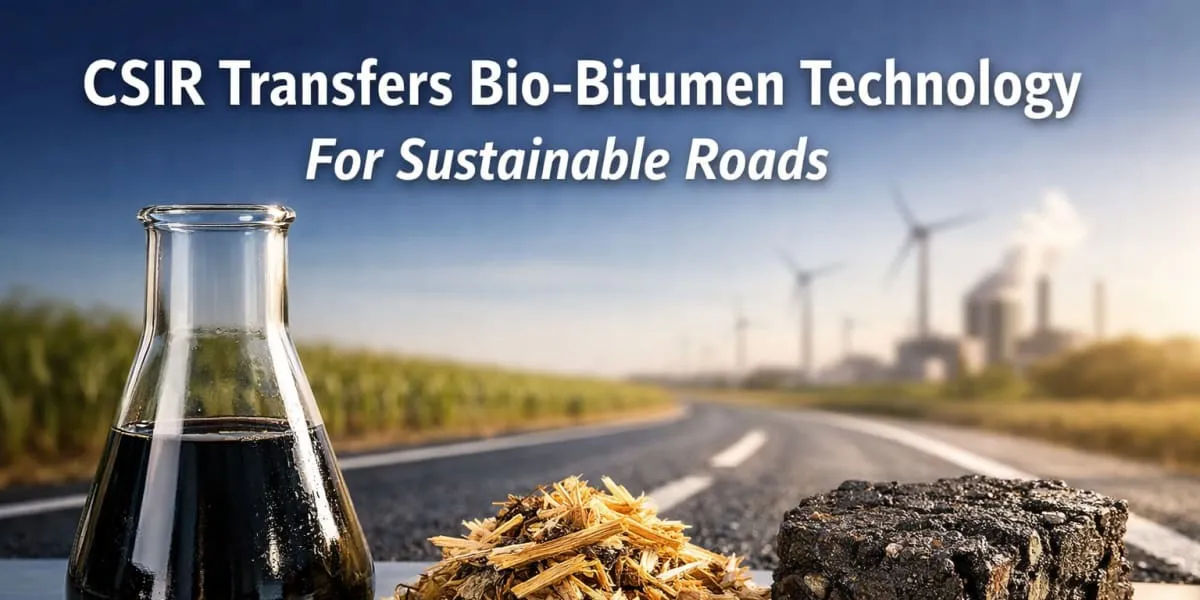
The production route uses thermochemical conversion to create a binder that has demonstrated performance comparable with conventional bitumen while lowering lifecycle carbon intensity. Developers reported that the material is compatible with existing paving practices and can be integrated into national highway projects. The technology is positioned as an environmentally friendlier and cost-effective alternative for road construction.
Officials said adoption would create additional income streams for farmers and reduce pollution from stubble burning, thereby improving air quality and rural livelihoods. The initiative was presented as aligning with Net Zero targets and flagship programmes that support self reliance, circular economy principles and bio energy development. Stakeholders noted that scaling up will depend on public private partnerships and supply chain development.
CSIR confirmed its commitment to support industry uptake through demonstrations and licensing arrangements and continue rolling out technologies for national development. The transfer represents a move towards substituting petro based materials with bio based alternatives across infrastructure supply chains. Observers added that widespread implementation will require coordinated action across ministries, research institutes and private sector partners.