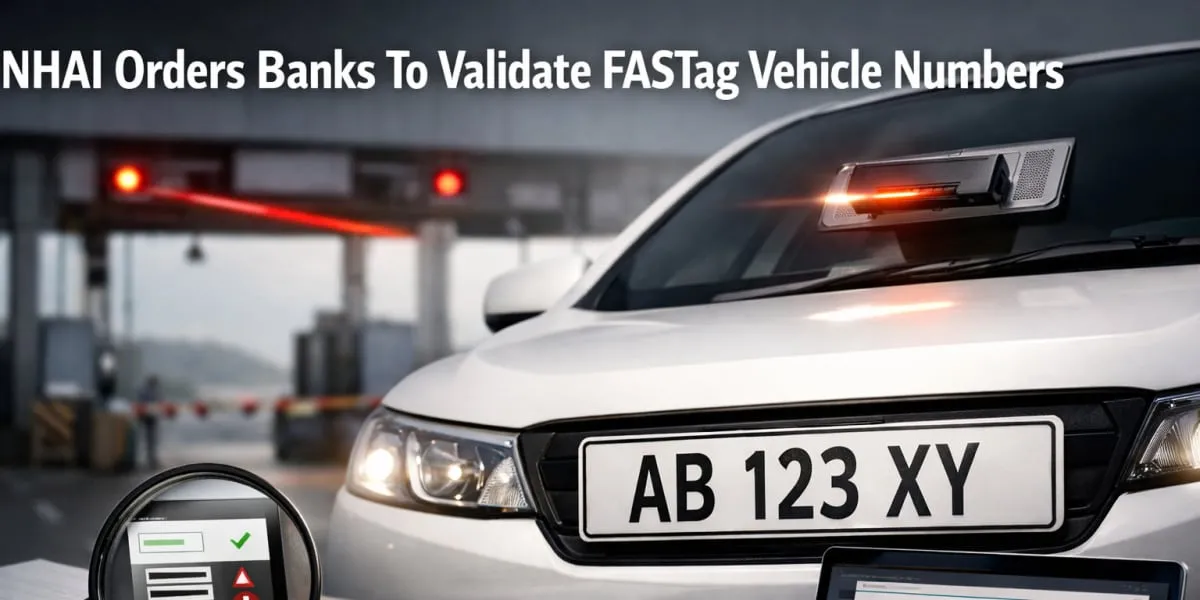
The instruction is intended to enhance the accuracy and reliability of data in the Electronic Toll Collection (ETC) system and to strengthen transparency, compliance and operational efficiency. The NHAI stressed the critical importance of correct VRN mapping with FASTag in view of upcoming technology driven initiatives such as Multi-Lane Free Flow (MLFF) tolling. Under the MLFF framework, enforcement actions including issuance of electronic notices to non compliant vehicles will rely on accurate and verified vehicle identification data.
NHAI officials said that a considerable number of mismatches had been associated with FASTags issued prior to integration with the VAHAN database, when validation mechanisms were relatively limited and manual processes increased the risk of inconsistencies in vehicle identification records. In response, all FASTag issuer banks have been instructed to undertake urgent verification of FASTags issued by them and to blacklist those FASTags found to be linked with incorrect or invalid VRNs, in accordance with established Government guidelines.
The NHAI has also noted that it issues over 0.5 million (mn) FASTag annual toll passes and collects Rs 1.5 billion (bn) in toll revenue, figures that underline the financial scale at stake. The agency indicated that tighter VRN validation and coordination between issuer banks and the VAHAN system are expected to protect revenue streams and support smoother deployment of technology driven tolling reforms. The measure is part of broader efforts to modernise toll operations and reduce evasion.