
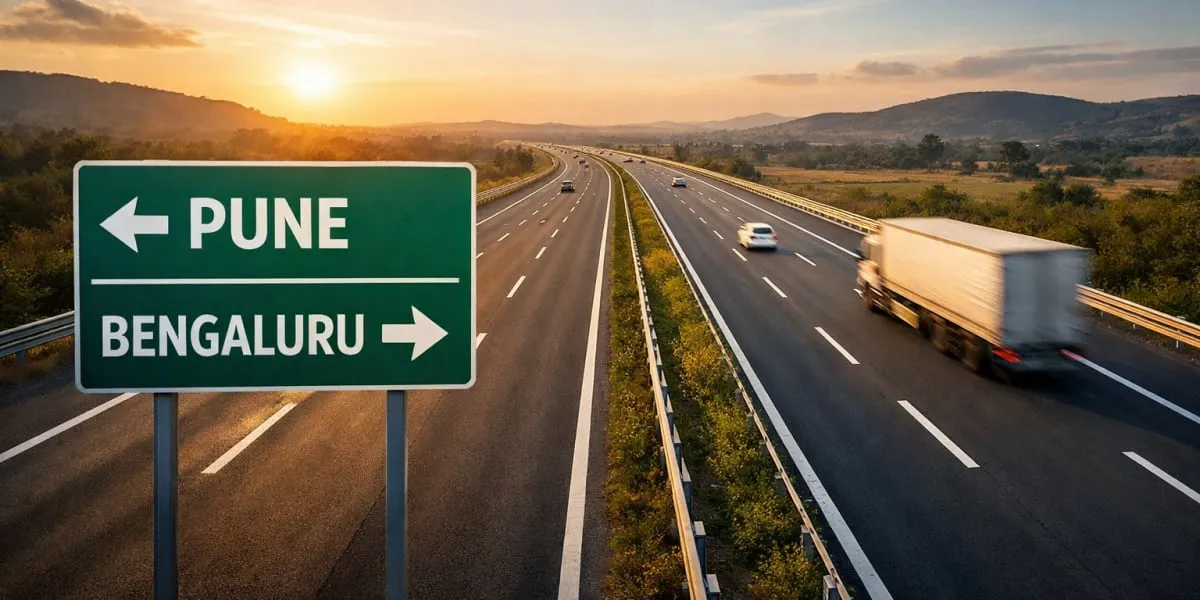
The corridor will stretch for 700 km and will be constructed as a six to eight lane expressway designed for high-speed movement of passenger and freight traffic. The estimated cost ranges from Rs 450 billion to Rs 500 billion (Rs 450 bn to Rs 500 bn), reflecting land acquisition, construction and allied infrastructure. Project planners envisage modern design elements and grade-separated junctions to sustain consistent speeds and reduce bottlenecks.
The proposed alignment will pass through Pune, Satara and Sangli in Maharashtra before entering Karnataka via Belagavi, Vijayanagara and Davanagere and then reaching Bengaluru. The route selection is intended to bypass congested stretches on existing highways and to provide a more direct corridor for long-haul vehicles. Ancillary works are expected along the alignment to support service areas and interchanges.
Currently road travel between Pune and Bengaluru takes about 14 to 15 hours owing to traffic, narrow sections and frequent delays on the present network. The new expressway is projected to halve journey times to about seven hours, thereby improving transit schedules for intercity buses and reducing logistics turnaround. Faster and more reliable movement is anticipated to lower operating costs for transport operators and improve supply chain predictability.
Beyond travel time savings, the corridor is expected to stimulate regional development by attracting industries, warehousing and logistics parks near interchanges and by generating construction and operations employment in adjacent districts. With the approval process approaching completion, authorities have indicated that attention will turn to tendering and detailed engineering ahead of mobilisation.