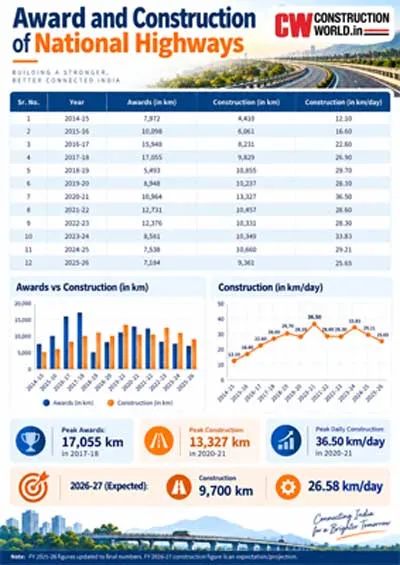
Recently, during the Indian Construction Equipment Manufacturers’ Association ( iCEMA) AGM, the mood was somber. While mining and real estate had provided great relief, the usual cheerleader, namely the road sector, had let everyone down. So, to put the record straight, Ministry of Road Transport and Highways (MoRTH) awarded around 7,184 km of roads in 2025-26, down from 7,538 km in 2024-25. Road construction by MoRTH is expected to remain at around 9,700 km in 2026-27, compared with 9,361 km in 2025-26. So, while road construction was down by 12% and awards have been lower by 5%. With the projection of a 9700 kms expectation the road sector will see an uptick of 5% this year. Road connectivity is aimed at enhancing speed of delivery from farm to markets and for commerce and industry to reduce cost of deliveries.
Moving goods by road in India has cost roughly ?3.78 per tonne per kilometer (PTPK), compared to just ?1.96 PTPK by rail. By pouring the ?2.93 trillion budget heavily into expanding rail capacity, the government is orchestrating a structural modal shift of cargo from highways to tracks. Indian Railways has meanwhile, electrified over 99.6% of its 70,271 route-kilometre broad-gauge network, establishing itself as a global leader in green mass transit.
On logistics, the government has made major moves and some of them are nearing fruition. Both of India's primary Dedicated Freight Corridor (DFC) networks are now fully completed and operational creating a continuous 2,843-km freight rail backbone across the country. The entire 1,506-km Western Dedicated Freight Corridor (WDFC) connecting Dadri in Uttar Pradesh to the Jawaharlal Nehru Port Trust in Navi Mumbai is now operational. Similarly, the 1,337-km Eastern Dedicated Freight Corridor (EDFC), which connects Ludhiana (Punjab), passes through Haryana, traverses the length of Uttar Pradesh, and terminates at Sonnagar in Bihar. Freight trains on the EDFC operate at speeds ranging between 50 kms to 75 kms which is a huge escalation over the previous 25 kms/hour, dramatically slashing transit times and run fully electrified cargo operations, completely isolating coal, steel, and agricultural freight traffic from passenger lines in the eastern sector. The WDFC too has slashed commute times by two-thirds. Dankuni in West Bengal has got a new lifeline. Dankuni will be directly connected to the western side of the country via the newly sanctioned Dankuni–Surat Dedicated Freight Corridor. Formally announced in the 2026 Union Budget, this massive 2,052-km cross-country freight pipeline will cross six states (West Bengal, Odisha, Chhattisgarh, Madhya Pradesh, Maharashtra, and Gujarat) to bridge the gap between eastern industrial/mineral hubs and western maritime grids. Pre-construction activities and land acquisition notifications are actively underway for this route.
On 15th October 2026, the 12th India Construction Festival and the 30th Construction World Annual will reveal India’s fastest growing construction companies. The volume of information in the 30th Construction World Annual, I promise, is not available anywhere currently.
Go grab your copy of the 30th CW Annual 2026, it is a BLOCKBUSTER!
- PRATAP PADODE is Founder & Editor-in-Chief of Construction World & FIRST Construction Council